Saturday, September 10, 2011

Remember Me and 9/11: Too Soon? - 10th Anniversary of September 11th Post

-jessegirl- September 11, 2011


Blue sky day
Ten years ago, to the day, the U.S. suffered the horrific terrorist attacks on the World Trade Center in New York City, and on the Pentagon. The heroic efforts of the passengers on board flight #93, who sacrificed their lives to abort another planned attack, prevented further carnage. At the end of the day, 3,000 people had perished people from many nationalities and faiths.

Those of us, who witnessed the events, whether live or on TV, have the images burned into our brains and we will always remember where we were when that second plane hit. Although this loss affected us all, I would like to express my condolences to the families and friends of all of the victims, for your losses are personal and huge. I am so sorry. And I will hope you understand the spirit in which my words are written, lest we forget.

I revisit, yet again, the film Remember Me, and its place in memorializing this enormous loss. It has become even clearer to me that since it was released in March of 2010, this film is one of the best tributes to every individual who was lost that day.



Too Soon?
Was Remember Me made ‘too soon’ after the event? Some detractors criticized it for that. Well, first of all other films preceded it. World Trade Center, with Nicholas Cage, 2006, for example, was five years after the fact. And Adam Sandler’s Reign Over Me came out in 2007. The lauded From Here to Eternity, about Pearl Harbor, was out in 1953. When is the right time, after 10 years, 15, 20, 25, after a generation has passed?

People thought it was too soon because, as I read it, the wound was still too raw.
“I left the movie theatre feeling like I’d been psychologically assaulted because I did not choose to see a film on that subject. That is not what I signed up for...Maybe a scant 8.5 years had dulled the memory of the masses, but it’s too soon for me...I wasn’t prepared to be unwillingly made to relive that day.” [Sara. March 16, 2010. –Brevet]



Remember Me’s Power
Let’s backtrack. What does Remember Me actually do to some people, to a lot of people?

It has the power to tap into our grief in a big way. It ferrets out our memories of 9/11 and brings them back in painful detail. It also seems to root around the wounds in our hearts and makes them bleed again. We are brought right back to our own personal losses in a visceral way. We suffer, yet again, the loss of a husband, wife, child, and others dear to us. We start pondering other types of loss, divorce, rape, and so on. Unhealed wounds come to the surface to hurt again. Remember Me is like a trigger for any trauma we have experienced and perhaps trips us up, forcing us to experience PTS symptoms. It is all very personal and strong. When you think about it, so many people are the walking wounded, for so many reasons, having suffered various types of personal trauma.

“...this was supposed to be an assault on the senses. It is a wakeup call to everyone to not take each day for granted...My mother was murdered very similar to the scene in the subway...Films can’t disclaimer everything. We all have had things happen to us that we probably would rather not remember...but sometimes we need to be reminded so that we can grow and change for the better.” [Tamara. March 18, 2010. –Brevet]

Indeed, one big reason people were commenting so passionately about the film was to
share their pain with others. Those of us who read learned this fellow commenter had had a miscarriage, that one was abused, another had lost a child, yet another survived a terrorist attack. The stories poured out of hearts, couldn’t be contained. The pain kept coming. It was astounding.

People are shaken to the core. It is not just a sad movie, a tear jerker. It is a tragedy, and I don’t think our society makes us really ready to accept tragedy into our lives. Under our society’s influence, we do not see the benefits of tragedy. I have discussed Remember Me as a tragedy in past posts and I don’t want to go over old ground again here. [The Tragic in Remember Me and
Tyler in Remember Me - The Human Face of Tragedy


The poster, Sara, blamed the movie. I am sorry for her pain but that was not the right target. I like what this person had to say about it:
“Any movie at any time can call to mind upsetting or unsettling events in our own lives. We can’t be sheltered from them and we can’t always know ahead what is coming. That is a bit of the message of Remember Me.” [ShariG –March 22, 2010. –Brevet]


So what about grief? Remember Me explores grief, which is its major theme, the grief of the characters who have lost a brother to suicide, a parent to murder. Then, at its climax, it drives home the point relentlessly with Tyler’s death in the North Tower. The key character, who had been dealing with his own grief throughout, was now being grieved. Not only was that, the whole nation, the world, thrown into grief. It was too much. It was heartbreaking in a primal way. One couldn’t get away from it. It was everywhere.

Grief is part of the human condition. We have humor. We have joy. We have fear. We have grief. Films give us all of these. Why should Remember Me’s story offend? The tie to 9/11 reinforces its power to affect us strongly. To haunt, as so many viewers have said.

It shoves us up against the wall. We have nowhere to run. We must deal. If Remember Me’s story had been told with crass disregard using 9/11 exploitatively, as some contend, then it could not have this power. It would be found out as a fraud. Grieving people would not feel this power if that were the case. They might not be ready to take on the measure offered yet, but that is another matter. “Some can deal with it, others not [yet]. But this says nothing about the quality of the movie and is surely not a reason to write bad reviews about it.” [Anne. March 17, 2010. –Brevet]

No one should be told how to grieve but it has been my experience that it cannot be avoided. It is excruciating agony. It is zoning out. It is, at times, inability to cope with the usual life commitments. It can be tears, insomnia, catatonic-like behavior, overeating, not eating, letting oneself go, depression, fear for loved ones, panic, general anxiety, obsessive behavior, inability to concentrate, and more. Intense grief can contribute to substance abuse, to divorce, to suicide even. The circumstances around some grief can be hugely traumatic, not easily absorbed.

Some people don’t want to talk about the lost one and others want to talk incessantly about the lost one. Some people put photos away, and others put them all over the house. Some people can no longer listen to music. Various things can trigger relapses, instances of acute grief: certain pieces of music, certain words, a memory, a movie, a friend’s face, a building, a street, -anything really. And in many cases these triggers cannot be anticipated.


Not Ready
Remember Me is a trigger for so many, on many levels, and some people just cannot deal. When I talked about Remember Me as a tragedy I talked about the great alchemical transformation within us. We can be changed, moved, touched, and brought to greater awareness. We can be put in touch with the well of tears at the center of the world. But we must go through the pain. There is no way around it. None.

“And to those who are angry and feel as though they’ve been sucker punched by this, I do understand where you’re coming from. I, too, was profoundly affected by this event on a personal level. But at some point we must face this and we haven’t yet. Generations past have faced their tragedies and so must we. I’ll concede this, with being less than 10 years...perhaps it’s a tad too soon for a film like this. Maybe...Yes, we are still in tremendous pain over it. But at some point, we must face it.” [Nikola. March 16, 2010. Brevet] Yes, I agree, we must face it.

But some people are not ready for it. That is not a criticism, just an observation. For them, Remember Me’s message is ‘too soon’. Perhaps they lost someone on 9/11 and haven’t gotten to that place in their grieving which allows them to absorb the power of Remember Me. Grieving is a very individual process, even if it has aspects similar for all. And those famous five stages do not necessarily come in a particular order or last for a pre-set amount of time. Grief is fraught with backsliding; it is not a constant regression at all. It is mercurial, unpredictable, can burn one moment and lie dormant the next. And, until we die, it can re-appear, because, even when we have resumed some semblance of normalcy, it is still there. The lie is to think we get over it. We are never fully, ‘over it’, even if we have gone through it. We just live with it.

When the people who are not now ready for Remember Me’s message get to the place where they are ready, this film will be able to work its transformative might on them. They must wait. Abusing this beautiful film is not the answer. They must wait. And when they are ready, must crawl before they walk, walk before they run, run before they fly.


Would we rather be unaffected?
Now if a film has the power to tap into our grief, perhaps this is a call to attend to it in some way. Very few films can do this. I know for a fact that Remember Me has this power. It has this power over me and has had it over others who have commented on public blogs and websites.

If it has this power, does that mean it is too soon after the tragic event? The real question is, would we rather be unaffected? Really? Would that not mean that the event meant nothing to us? Being immune might just mean we are callous. Because the pain means it matters, the dead matter.

Here’s what a couple of viewers had to say: “Yes, this movie packs a punch. I just don’t think that’s a bad thing...Should it be painful to remember? Yes. To me this film is a touching, respectful way to do just that: to remember.” [Karen. March 28, 2010. –Brevet]

And: “...it is a movie that will move many but will also cause great pain to others and that is what the power of movies can do, whether good or bad.” [Linda L. –March 17, 2010, answering someone who had wanted warning. –Brevet]

If Remember Me has the power to tap into grief, does that mean that one should attend to it? Does it not mean that it was made ‘just in time’? If Will’s story had been filmed later, if they had waited longer, would it have had the same impact?


The Young
I’m guessing that anyone younger than, say seven at the time, would forget, or would forget the import and meaning of 9/11 or would get a skewed perception of it due to their youth and the protection of their parents, unless they were right there, in lower Manhattan, and had to escape the raging dust storm. So anyone born between, say, 1994 and 2010 wouldn’t remember. And if they did, it was a history lesson.

From comments, it is clear that a certain demographic did not remember. “My daughter’s going to be 17 this year and we live in Europe. She knew about 9/11 and was taught about it in school by documentaries. But....only after seeing Remember Me she realized the emotional impact on all those people living in NY and in America. ..I think Remember Me should be shown in high schools ‘cause there are several themes’ worth to be discussed about.” [blackbeanie June 10, 2010 IMDb Remember Me message board]
And: “My daughter is really too young to remember 9/11, but this was a chance for us to talk about it...” [Pam. March 15, 2010. –Reesman] These are not the only people to report this phenomenon.

If you were 15 yrs. in 2009 and saw Remember Me — perhaps because Robert Pattinson was in it — you would have been seven on 9/11. Some of those viewers thought Tyler committed suicide, and that confused them [Kim, April 29, 2010. –Brevet]. They had no idea about September 11th. To those of us who can pinpoint our exact location during those 102 minutes it is inconceivable that teenagers wouldn’t know. And yet, this is exactly what has happened. “For the younger generation, people who were too young to be aware of what happened then but know about it now, maybe bringing such a monumental catastrophe down to such an intimate, personal level will help them connect and understand that day in a way they couldn’t before.” [Jennifer L. –March 17, 2010. –Brevet]

I read again and again that ‘everyone knows what happened that day’—said by people who state that they don’t need to be reminded—but in fact that’s not true. The point is that everyone does not know. The other point is that everyone does not really understand the loss. Given that it is a consensus that we must never forget it is puzzling why some people don’t want to be reminded.


Too Late?
What happens if Remember Me is too late? Some tragedies happened too long ago to have the same effect. They feel historical, in a time presumably different enough to be irrelevant except to impart a teary lesson in a remote way. It was so long ago. Like the Trojan War, even WWII. We care, we cry, and then thank God that was then, this is now.

But 9/11? Remember Me was in theatres less than 10 years after the attacks, soon enough for it to turn us inside out. It would force us to attend to our grief. No way around. It would force us to learn the lesson, hear Remember Me’s message. It would force us to find meaning, so that Tyler’s death, so that every one of those deaths, was not in vain.

Is this bad? Why is this bad? Grief is one of the worst things thrown at us in life but we have to bear it somehow.

In fact, those of us who assert confidently that Remember Me will become a classic someday must understand that its monstrous power might be muted the farther away from 9/11 it gets. We are the ones who can feel its full strength now, if we let it. Although, given its genius, its insistence on keeping everything at an intimate level, I could be wrong. Like any great tragedy, its power to affect us at the epicenter of our being would remain undiluted, because it speaks to the universal through the personal.



Remembering
One can remember things, even horrible things, in a removed way, hear a speech, shed some tears, and then go on with life as usual. People are upset about Remember Me because it does not allow them to just skim the surface of memory. Instead it is heart-stopping. It gets right inside and won’t let go.

People have noticed that Remember Me polarizes. For example: “The film is extremely polarizing and personal...I think a great deal of the reaction was over reaction and knee jerk.” [Sammie1863. June 19, 2011. IMDb. ‘Most honest film regarding 9/11’ thread.]

I have come to the conclusion that the two camps are: *-those who refuse to remember in a meaningful way, who shoot the messenger because they won’t deal with real pain. Some of these will genuinely not be ready. I respect those for whom it is really too soon. But some others do not have the emotional depth to care. They are the ones who happily and contemptibly shoot Remember Me down for no valid reason. **-those who brave the firestorm of pain to grasp the true dimensions of what was lost. It is only the latter who will appreciate the heartfelt tribute Remember Me is. It is only those who are willing and able to really remember September 11th, who have the emotional and moral fiber to do it. Now.



Cheapening, Elevating, Deepening
I quoted Pattinson in another post [Robert Pattinson in Remember Me: Part One]:

As an actor, you can elevate the human condition or cheapen it. I would assume it’s the same with anything you do- you try to elevate and maybe someday you will.”[Robert Pattinson, speaking to Jenny Lumet for Details, March 2010]

A couple of quotes from viewers note the cheapening aspect.
I believe the only thing shameful about Remember Me is the critics who have cheapened a noble effort without so much as looking back –almost gleeful in their determination to tell movie audience to stay away.” [Coopergirl. March 16, 2010. –Brevet]

“This movie is a tribute, not an insult to the memories of all those who were impacted. It cheapens everyone, from those responsible for this film to the viewers, to the actual victims of that horrific day, to say otherwise.” [Karen. March 18, 2010. –Brevet]

Actually, it is not possible to cheapen something so authentically crafted as Remember Me. The attempt says more about the person trying to do so than about the movie. The point of origin for mud slingers is the dirt on their own hands.

I will springboard off this thought. I think one of the things Remember Me does is not only elevate, but also deepen the human condition. This is just as important. Elevating and deepening. Deepening is driving into the heart of it, making it profound. It is a very internal thing. It is a place where you encounter and accept pain and suffering. Elevating is lifting up, raising up, supporting, perfecting.

Deepening and elevating are not exclusive and humans need both, need to do both.
Elevating is pointless without depth. I think one of the things Remember Me does is not only elevate, but also deepen the human condition. And it is never too soon for that.

~~~~~~~~~~~~~~~~~~~~~~~~~~~~~~~~
Article references:

1) “Reacting to Remember Me: an Interview with Screenwriter Will Fetters”, by Brad Brevet.March 16, 2010. http://www.ropeofsilicon.com/article/reacting-to-remember-me-an-interview-with-screenwriter-will-fetters This post finished with 355 comments from viewers.

2) “Controversial ‘Remember Me’ Ending: Dividing Critics and Audiences”, by Bryan
Reesman. March 15, 2010.http://www.moviefone.ca/2010/03/15/remember-me-ending-controversy/20This post attracted 441 comments.

3) IMDb: Remember Me message boards: Various threads.

4) “Robert Pattinson on Life beyond Twilight”, by Jenny Lumet. Details. March 2010.
http://www.details.com/celebrities-entertainment/cover-stars/201003/twilight-star-actor-robert-pattinson-remember-me

Wednesday, September 7, 2011

USA Today - Remember Me Mention


In relationship to the upcoming 10 year anniversery of 9/11, USA Today looked at some of the films which dealt with aspects of the attacks.
Remember Me was included and producer Nick Osbourne commented on the film's ending.

Films such as Oliver Stone's World Trade Center (2006) and Paul Greengrass' critically lauded United 93 (2006) found respectable audiences while fending off criticism when sensitivities were still high. The criticism even stung films with a tangential relationship to the attack, such as 2010's Remember Me. The Robert Pattinson drama featured a 9/11 surprise ending, which took a "drubbing" says producer Nick Osborne.

"Everyone was, to a certain extent, terrified of doing it," Osborne says. "It's such a sensitive topic. But it was the right ending."


To read the rest of the article, please click here:
USA Today.com

Thursday, June 23, 2011

Tyler’s Journal in Remember Me: A New Look

~by jessegirl~ June 19, 2011


The journal has always been important to me, for all the reasons above, and it was one of the first things I wrote about. After a whole year, I felt I had to revisit it, and this is the result. I think, in a way, all my RM articles are, in their way, tribute diaries, but public ones.

-jessegirl-


On the surface we see Tyler Hawkins—played brilliantly by Robert Pattinson—as a rebellious, spoiled guy, who smokes, drinks, parties and sleeps around, a guy who doesn’t seem to care about anything, who is prone to fist fights and destructive behaviour. And that is a view held by some viewers who haven’t bothered to delve deeper. Underneath that though, is someone struggling with long-standing trauma and grief, a young man filled with doubts, fear and insecurity. He is a lost soul trying valiantly to find his way back to a meaningful life. How do we know this? Largely, the key to discovering Tyler’s character is through his journal.


Cope


The journal started—one assumes—as a way of coping with the loss of his brother. Paradoxically, the journal is a way of bringing Michael’s death closer, in order to learn what Tyler can from it, and also a way of distancing Tyler from the horror of the death. A fourteen year old boy is traumatized by finding the body of his brother, especially the factually horrific specifics seen as a result of a hanging suicide. Writing deflects from those grotesque forensic details. Through the process of writing, the trauma is subdued, muted.


Loss provokes introspection, which, in turn, uses the written word to acknowledge what cannot be spoken. One must, after the death of a loved one, communicate with that one, and with oneself. If one has an artistic outlet, music or visual art, which might be the route one takes, to express the inexpressible. But for those with few skills in those areas, words must do, must be enough. And so, Tyler ‘talks’ to Michael. He ‘journals’.

Tyler needs the journal, to process his loss, to ponder and help him understand, and ultimately forgive Michael. The journal is the way to make the journey. Grief is a journey.


While Tyler merely audits his outer life—school, job, relationships—he engages fully in his inner life. There, he takes on gruelling studies, constantly testing himself, always pondering at the deepest level. That’s the place Michael must have gone, to the place where one goes to find the meaning of life and to act on what one finds there. Tyler, too, has to delve into himself and act on what he finds there. And it is one scary place, like the underworld.

Tyler has to find Michael there and like any seeker in the place of the dead, Tyler is afraid. He knows only that he must find his brother, rail against him, question him, find answers, cry for him, love him and forgive him. Tyler knows all that and it is extremely daunting work. It is the great unknown, and Tyler goes there fearing only that he might not be able to return. And it is excruciating work, like cutting an open wound, exposing his worst terrors. Tyler goes anyway. He has to. He is compelled. He must ferry himself down into the depths of his soul, explore, find answers or some resolution, and then come back up again. Or die. It is exactly that significant. It is a matter of life and death. And when, or if, he returns, he will be transformed. Nothing short of that will allow Tyler to return and engage in ‘real life’ again. The journal is his tool, his pen the pick axe which will excavate these inner recesses of his soul so that he can bring them to light.

Combat

When someone kills himself, we always ask, ‘why?’. We think about how much he had going for him. For Michael, it could have been: young, smart, talented, rich. Then we shake our heads, perplexed. But the outside is never the inside and Tyler is trying to figure out what was inside. What made Michael think life was not worth living? And was he right? If not, then what makes life worth living? Existential doubts and questions abound. Michael gave in to despair, gave in to his Dad.

But Tyler fights. He figures himself out through the journal. It is part of his fight, his internal battle, just as his argument with Charles in the boardroom is his outer fight, his attempt to find hope. Tyler tests himself against his Dad all the time, sometimes with foolish, self-righteous bravado and other times just to establish his own identity (‘I don’t want you to bail me out.’)


So the role of the journal has mutated, become a way of discovering his identity. Tyler asks: ‘Who am I?’ He fights to separate himself from his brother and his father. Part of the battle is expressing his anger to Michael. ‘Why did you abandon me?’ ‘Why didn’t you stick around for me?’ Admitting the anger verbally is taboo so his feelings are expressed in the diary. Tyler fights for identity, meaning and understanding.

Comfort

Have you noticed how Tyler carries the journal around with him, how he secures previous pages with elastic bands, how it is there with him in the office that day? Tyler needs his journal like he needs air. It is not with him when he dates or visible when Ally is around, but otherwise it seems to be constantly present, like a security blanket. Sometimes, its presence makes a statement and other times it just reminds us it is there. Here are a few ‘sightings’.

1. The first day we see Tyler, he goes to the cemetery with the journal bulging from his jacket pocket.Charles says to Tyler: 'You couldn't wear a tie?' as if to point out Tyler's disrespect of the ceremony. Tyler was, yes rebellious, but only disrespectful to Charles, not to the ceremony. Because the presence of the journal, right there, is his 'tie', his connection to and respect for Michael."


2. From there, he travels by subway, goes straight to the diner to write. Food stays uneaten. You must not eat in the Underworld.


3. At the diner again, he writes and we hear his voiceover about castrating the father.


4. When Aiden tries to interest Tyler in the campaign against Craig using Ally, Tyler is sitting on his bed writing in the diary, then rolling up older portions. We see a half-eaten sandwich there, which he later trashes; again, he’s too preoccupied to eat. Aiden takes the journal for granted.


5. When Tyler leaves a sleeping Ally a note—Please don’t leave. I’ll be back—he uses a piece of his distinctive journal paper. This was to hand, no doubt, but nevertheless, it brings the journal back.


6. He goes to the diner again, the usual place. The journal comforts him and he has established a routine around it. When he meets Janine there, she teases him, wondering if he’s writing anything bad about her. ‘Not today’, he answers. So, the presence of the journal in Tyler’s life is well-known.


7. When Tyler returns from this outing, his note to Ally is propped up on the night table while she waits for him. He then explains where he went. Tells her about how he writes to Michael and had to tell him about her. This makes her part of his inner circle.


8. Labour Day weekend, at the beach, Tyler is once again, writing. So, he writes inside and outside on the dunes too.


Significantly, Ally doesn’t hesitate to toss the journal aside and tackle him.
Tyler is not upset about this, just laughs and kisses her. But there he was, writing even when he’s near his lover.


9. We see the older parts of the journal, those Tyler left at home, when Neil reads them. These private thoughts are strewn across the bed in violation, instead of curled neatly into protective rolls.


10. The last morning, Tyler leaves Ally in bed again, and takes the diary to his Dad’s office with him. It is his comfortable old shoe and a work in progress, never finished. The camera follows the journal as Tyler handles it before he leaves. Pattinson’s long fingers work it with an elegant grace, which transmits, already, the tranquility that is Tyler’s that morning. By the time the camera gets to the sleeping Ally, we are so mellow. Like the camera work.


11. In his father’s office, he puts the journal on the desk, and reaches for the mouse.


As Janine and Tyler view the screensaver, you can see the contrast between the old, battered journal, which looks like it has been in a war, and the pristine, clean, new desk top. There it is, making its own statement on Charles’ desk. Tyler sat down in his father’s chair and claimed a temporary spot on the desk for his journal, but this is not supplanting the father. It is just that Tyler finally feels comfortable in a part of his Dad’s world.


12. And then, at the end, we sight the journal in the rubble while we hear the last voice in the film, Tyler’s, giving us his last sweet words.

Confidential

We don’t know what is in the journal except when we hear Tyler’s voice overs, for example, when he addresses Michael about the son castrating the father, or when he tells Ally he needed to tell ‘someone’ about her. Aiden doesn’t ask, or, probably doesn’t want to know. Janine doesn’t really pry when she asks if she’s in it. Tyler’s inner circle knows about it but respects his privacy. As with many diary-type journals, Tyler’s is very private. That gives him free rein. He has a place where he can be uninhibited, a place to work through everything without censure.

Getting a good look at it would be getting a look at not just his thoughts, but also his soul. He sits there in the diner, a regular, and the waitress brings him something and instructs him to ‘eat’. You don’t think of things like eating when you journal that way. Time gets away from you because you are totally absorbed. The world around you, even in a busy diner, with people talking, coming and going, with the noises of cutlery and dishes, with the cacophony of sounds from the city street intruding, all is just white noise. You don’t hear or see it. You are in the underworld with your brother, groping in that dark, hoping you can hear his song, him strumming his guitar. You are in a private world. That is your real world and the outer one recedes in a blur.

Neil Craig’s intrusion into both Ally’s journal and Tyler’s was violation, never mind its purpose. Imagine Tyler coming home to find Craig not just inside his home, not just inside his bedroom but inside his journal, inside his most private life.


How much did he read, I always wonder? How much does he know of Tyler’s ranting, his secrets thoughts and uncensored feelings? For this adversary to violate his privacy like that must have mortified Tyler. For this man to see his soul, his wound, his sins. In point of fact, Neil must not have seen the newer entries, the part Tyler took with him to the beach, and the parts where he, no doubt, reveals his love for Ally. So Neil has a partial view, and judges based on that. And Tyler doesn’t defend himself because he feels guilty.


For in that journal would be things only meant to be between Tyler and his God. The journal is the womb for Tyler’s transformation. In it is the fragile embryo which must stay hidden until it can survive the light of day. It contains nothing less than the new life which will come out of Tyler’s grief. It is that powerful. However, Neil’s discovery is the impetus for Tyler’s confession; he’s been found out and he cannot avoid it anymore. Time to ‘man up’. Ready or not.

Commemorate

Writing in the diary is also a little ceremony; every time Tyler does this he commemorates the life of his brother. The journal is a place of honour. It is where the memory of Michael is realized and stored. We honour lost loved ones in various ways, with reverent acts and rituals. We etch their names onto granite on grave stones, create videos and other visual memorials, and so on. We tell each other stories. We know, instinctively, that we must never forget.

But we also honour them with our pain. The absence of the loved one hurts, and we record our suffering in journals. This is, in itself, a way of paying tribute to the dead. The last mark their presence left on you might be pain, but even that is a tribute. If that loved one didn’t matter, then it wouldn’t hurt so much to lose them. And if he or she didn’t make a difference in our lives, we wouldn’t try to remember. The journal is not just Tyler coming to terms with his brother’s loss, with the manner of it, with his own feelings about mortality; it is his way of remembering Michael. The dead always shout: “Remember me. Don’t forget me. I lived. I mattered.”


I’ve said this before, elsewhere. Tyler is a touchstone, leading us to the kind of remembrance we all need to cultivate. The film leads us to those deep places within ourselves which we need to find, in order to become more fully human. That’s why we can’t get this film out of our heads. Exploring those places within ourselves can be painful, but this excavation is necessary. “It is important that you do it, because nobody else will.” And no one else will do it the way you do it. It is significant that after Tyler dies, what we see in the ashes is the remains of his journal. It did its work for him, but through it, he still speaks. He knew, in the end, that his brother could hear him, so he told him the most important things: “I love you. God, I miss you...And I forgive you.”

Cinematic Device

The journal is employed as a strong cinematic tool, and almost becomes, as the cliché goes, another character, although, strictly speaking, it’s just the inner side of Tyler. Allen Coulter and editor Andy Mondshein cut from Tyler writing in the diner that first day, to the scene where Caroline waits on the steps for her ride to school. The continuity comes from the voice over: Tyler from his diary, “Michael, you know what day I’m looking at...at twenty-two...Mozart...and Buddy Holly was dead.” Here the journal is the thread that joins the scenes, while letting us know what Tyler is thinking.


On another visit to the diner, the voice over comes as he writes. He expresses his anger at his father, talks about Greek mythology and about sons castrating a father with a scythe. In the next scene, when Tyler picks Caroline up from school, he gives her a book of Greek myths. She asks what happened to his face. He jokes that it was a threshing accident. What a weird outmoded choice of words. But a scythe was used in harvesting, which references back to the previous scene, which talks about castration. The book and journal tie together these two scenes.


In general, the voice overs, words coming from the journal, are the device used to state Tyler’s philosophical and emotional thoughts. The crystal clarity of Tyler’s last thoughts voiced over the ash-covered remains of the diary is a triumphant expression of spirit over death, and it is what we are supposed to take away with us. Those words were the last spoken in the film, and show the progress Tyler made on the journey he was on. We know an object like the journal would not have survived the firestorm from the blast at all; its presence on the ground is purely symbolic, and very effective.


The journal was also just a prop. Think about it. It wasn’t a lap top; it was just an old- fashioned, simple, portable tool. By the end it looks like an object from the past. Not new and shiny but old and worn. The leather cover was very distressed, to indicate long use. Scraps of coloured paper or post-its were stuck inside it, as was a napkin and paper clips. These showed that Tyler must have thought of things to add to the diary when it wasn’t with him. It was a messy, wonderful object.


Props are funny things, part of the pretend world, physical illusions. At one point the producer reminded Pattinson to write in the journal, and, in some interview, the actor joked that he had scribbled pornographic poems in it. Who knows? The prop was auctioned off, as were some of the rolled up bits. I confess to a real hankering for that diary, that stupid bit of illusion, in all its sullied glory. All symbols are so much more though. It really is, for me, in some way, a magical object, handled by a fictional character. A real yet false thing. Still magic.


*********


Original Version Posted on http://


regardssurlefilmrememberme.blogspot.com on June 6, 2010


Original Version First Posted on www.rememberme-film.com on June 13,


2010


Thursday, June 2, 2011

Remember Me's Message - Remember the Fallen

Bin Laden is dead. We remember the Lost Loved Ones.

-jessegirl- May 27, 2011


Anderson Cooper360, on May 3, 2011, released a message from the newscaster, which essentially went back to the idea of remembering. Bin Laden’s crimes should be remembered but his name should not be. It is the names of the 3000 fallen that should be remembered. Hearing his newscast prompted me to this place again and I will quote below, as accurately as I can:

“It’s a relief to know he’s gone...Someday...cannot give Bin Laden the satisfaction of speaking his name... “I keep thinking of him now buried at sea, wrapped in a white cloth in a weighted bag, slid into the icy ocean...think of his body sinking into the sea, disappearing into the dark depths of the oceans...this man who terrorized so many for so long has simply disappeared. The ocean is a very big place and in the end Osama Bin Laden was a very small man. There will be no grave marker for him, no place for fanatical followers to come and pay their twisted respect. He is gone. We cannot forget or should we ever forget the horrors that this man unleashed but as the months and years pass, I hope that his name is hardly ever uttered. I hope his picture disappears as well... I hope it’s not the wasted life of this mass murderer we remember; I hope instead we recall the lives of those we’ve lost. I hope we remember Leon Smith Jr. (firefighter)... In the years ahead I hope it’s their names we speak, not Bin Laden’s. I hope it’s how they lived their lives we remember...I hope we remember all they did and all that they never lived to do.”
Anderson Cooper360, on May 3, 2011

(On AC360.com you can learn about those who died.)

The unfortunate thing is, we cannot remember the 3000 names. We do not remember the names of the victims of 9/11, of other massacres, whether large or small. We do remember the names of the perpetrators. I will not list any here. We know them. But we do not, nor can we memorize or know those whose lives were lost, who, in this, were innocent. That is just the way memory works. There are too many.

It is ironic that after Anderson Cooper made that statement, subsequent coverage on his show and other CNN shows covered Bin Laden and his demise in great detail from all angles, the murderer’s name repeated over and over. Should the picture of the dead terrorist be released, or not? What role did Pakistan have? How would the terrorist network continue? And so on. The focus was still on Bin Laden.


But the paragraphs I quoted reminded me that it has come full circle. It has brought back, for me, Will Fetters’ idea, the original inspiration for writing the script of the 2010 film Remember Me. To remember the fallen, through the story of one such imagined life, Tyler’s. Remember Me was never about Bin Laden or his terrorist network. It was always about remembering the individual lives lost, imagining what their families’ lives must have been like afterwards. And that’s where the focus should be.

For Will Fetters it began with the obituaries, The Portraits of Grief, New York Times "Portraits of Grief" the mini-biographies of those who had fallen on Sept. 11, 2001. It was from those that the writer had derived inspiration for his work, originally titled, Memoirs. (Therefore those who criticize the climax of the film as being a ‘twist’, ‘tacked on’, are sadly mistaken.)

The whole point of this movie was to remember an individual life. Granted it was a fictional character’s life, but this allowed everyone to become immersed in his world and come to love him, and then, grieve for him when he was suddenly snatched away in the most shocking way. Tyler died in the center of the first firestorm when the plane hit the North Tower of the World Trade Center. And that gave us all a chance to grieve. That is the genius of the film Remember Me.


Some of us took that rich source of emotional catharsis and were grateful for this chance. Others, to this day, felt cheated, angry, and manipulated, which are the common reactions to shock. These responses are still dividing viewers. But they tell us more about ourselves than they do about this film. About whether we allow ourselves to feel and to be open. About how grief affects us. Tyler at the window, the climax, is the culmination of all we feel about Tyler and all we will feel at his loss. If we felt nothing for Tyler—which I find an odd response—we are bound to feel manipulated. If we came to love him—and Robert Pattinson’s nuanced, authentic performance worked to make this happen—then we were put in the imagined position that those who suffered real personal losses that day felt. There was no better way to drive the point home.

Fetters was only 22 years when he wrote the script; he was a young man who shared with his protagonist, idealism. And in Remember Me, Fetters intended to force viewers to confront the horror of 9/11 in the most personal way, the only way possible for those who did not lose loved
ones there.

As I have written in another article, Tyler Hawkins, the imagined one, is the symbol, the human face of tragedy. [Tyler in Remember Me: the Human Face of Tragedy ] Through his story we come to understand the event intimately. We, the viewers, are brought to it by being shocked. And this is what happened on that bright Tuesday morning, almost ten years ago. Shock.

Some viewers recoiled, as the slap in the face was felt as an insult rather than the wake-up call Fetters meant it to be. Perhaps it worked too well, that shock. Shock makes one angry. The stunning force of it infuriates. And then comes the pain.


This is what is must have been like, Fetters’ story shouts. This is only one imagined life, cut short. This is an unfinished life. This is what 9/11 did. This is what hatred and terrorism did. There are 3000 stories, real ones, and 3000 families and their friends who have suffered immeasurably because their loved ones‘lives were taken.

If, for a few months, we walked in the footsteps of any of the 3000 who were brutally murdered that day, until their demise, we would get to know them. None were perfect, as none of us are. The fictional Tyler was not either.

One effective way we can remember the fallen—we who did not suffer the fate of a personal loss that day—is by remembering the symbol, like Tyler. Also, I have read a book one wife wrote about her loss and that kind of story can bring it to the level of a real person lost. Abigail Carter wrote eloquently of her husband, Aaron, who fell that day. If I can take the liberty of quoting her:

“Perhaps the nature of his demise had itself been the lesson: life needed to be lived and not spent at work. Life was not all about making money. Life was about those that you love. Life was short.”
(page 121)

This sounds a lot like the message of the film, or part of its message. Abigail goes on to walk us through her own grieving in detail, and shares with us her husband Aaron’s likes, his foibles, his character. For anyone wishing to remember a real life, her book is a good avenue. [The Alchemy of Loss: A Young Widow’s Transformation, by Abigail Carter. McClelland and Stewart, Toronto: 2008. ISBN-13: 978-0771019074; ISBN-13: 978-0771019050]


Every one of those 3000 families, the mothers, fathers, wives, husbands, children, all felt the giant fist in the face that day, the gut-punch which rendered them stunned, obliterating rational thought and giving way to an enormous, never-ending silent scream, a scream which has, in the almost ten years since, receded to an ever-present growl, but which threatens to overwhelm and be let loose anytime.

Families of the fallen held in front of them photos of their loved ones. Have you seen this man, this woman? Remember him. Do not forget her. The genesis of the movie Remember Me, its raison d’être, comes from such things, -one person holding a photo of his loved one. That person wanted the loved one to be remembered. And that’s what Will Fetters wanted when he wrote this story. Remember the fallen.

Monday, April 11, 2011

Remember Me Walking Tour

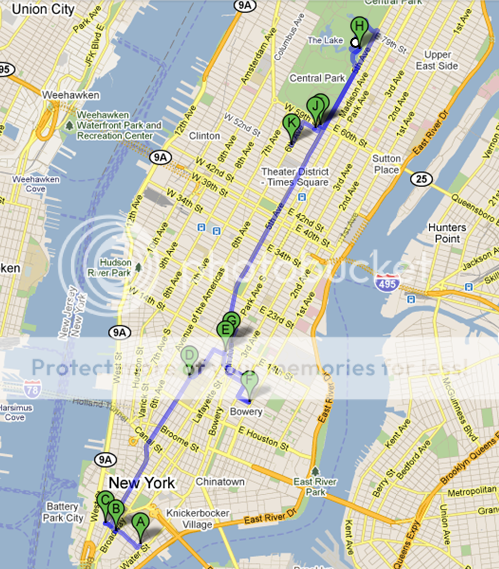
For those of you going to New York City this week-end and for all others who can't make it that particular week-end, here is the Remember Me Walking Tour in mobile form. While the site will show up on your computer as a regular blog, it will show up on your phone in the easy to read mobile format.


The entries come complete with a description of the location, some still from the film and walking / subway directions to the next location on the tour.


The Gandhi Restaurant, Noguchi cube and the Paris Theater are included as side trips and there is an entry for Eddie's Sweet Shop too!


Click here for the link to the site:


Key:


A - Pearl Street Diner - 212 Pearl Street


B - Noguchi Red Cube - in front of 140 Broadway


C - Tribute WTC Visitor Center - 130 Liberty St


D - New York University


E - Strand Book Store - 828 Broadway


F - Gandhi Restaurant - 350 E 6th St


G - Union Squ/14 St Metro Station (not station in the film)


H - Alice in Wonderland Statue - Central Park (East side)


I - The Oak Room - at the Plaza Hotel 1 West 58th St


J - Paris Theater - 4 West 58th St


K - Hilton New York - 1335 Avenue of the Americas